UK FinTech Week 2026: A Reminder That the Spirit Is Still There
What an incredible week at Innovate Finance Global Summit and UK FinTech Week. The energy, the innovation, and the conversations around financial inclusion and emerging market fintech were truly inspiring.
There were many highlights, but here are my top picks:
Ringing the opening bell at the London Stock Exchange with Endeavor was a moment that perfectly captured the spirit of supporting high-impact entrepreneurs scaling globally. The organisation, which operates in major cities around the world, supports the crème de la crème of scaling companies - yet its profile remains lower than it should be. While Y Combinator dominates the conversation around startup ecosystems, Endeavor's unique model of vetting and supporting only the most exceptional growing companies in emerging and growth markets deserves equal - if not greater - recognition. I hope to change that in the future, at least here in the UK, by supporting Constanza Castro Feijóo, Head of London at Endeavor, in shining a spotlight on the talent that drives global tech innovation.
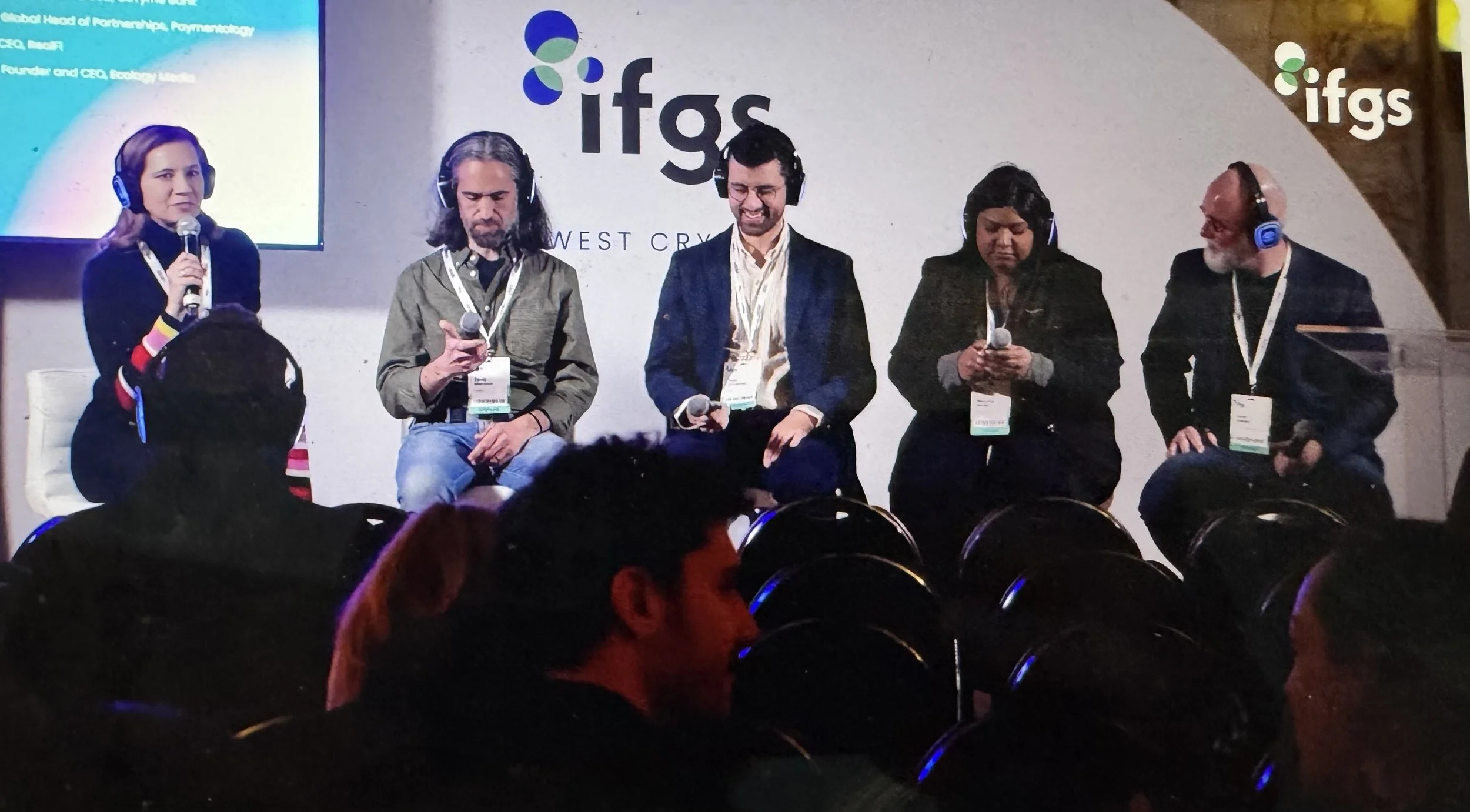
Left to right: Georgia Hanias, David Sherman (IO.NET) John O'Connor (RealFi) Merusha Naidu (Paymentology) and Coen Jonker (GoTymeBank).
Attending Endeavor's FinTech in Focus event at the opening bell was equally special - I had the pleasure of meeting incredible scaling businesses from around the world, entrepreneurs who are building the future of finance with vision, grit and purpose.
During UK FinTech Week's flagship event - the Innovate Finance Global Summit, I had the incredible good fortune to moderate a panel - "From Local Wins to Global Platforms: Leading FinTech Innovation From Around The World" - exploring how the most transformative fintech solutions are being built to address gaps in underserved markets. FinTechs from emerging and frontier markets are leading with innovation, leapfrogging legacy infrastructure, and setting new standards for financial inclusion, resilience and scale.
The panel featured David Sherman, AI and Financial Inclusion Strategist at IO.NET; Coen Jonker, Co-Founder and CEO of GoTyme Bank; John O'Connor, CEO of RealFi; and Merusha Naidu, Global Head of Partnerships at Paymentology.
Here are the key takeaways from the talk:
Infrastructure Is the Great Equaliser
David Sherman highlighted a sobering reality - AI startups burn 60% of their budget on infrastructure alone, and 80% of the world's GPU supply sits idle at any given time. IO.NET is levelling the playing field by providing distributed compute at 70% less cost than hyperscalers, enabling fintech builders in emerging markets to access the AI tools they need to bring products to market. This isn't just about cost - it's about who gets to build the future of finance. Products built in the US and Europe don't work for customers in Kenya, Ethiopia or South Africa. When you democratise access to computing power, you enable people to build products for the places they actually are - not just for the markets that already have everything.
Stablecoins Are Unlocking Real Financial Utility Beyond Crypto Trading
John O'Connor explained how $350 billion in stablecoins has evolved from a "get out of crypto" tool to genuine cross-border settlement infrastructure. With crypto, the transfer is the settlement - instantaneous, low-cost and programmable. Factories in Kenya are paying Chinese suppliers in USDT. People in emerging markets are using stablecoins to escape local currency volatility and access dollar-denominated savings with yield. RealFi has created its own US dollar stablecoin delivering 7-8% uncorrelated yield - in a market where the vast majority of stablecoins behave like dead capital. The regulatory conversation is shifting, with BlackRock tokenising treasury bills on chain and the US debating the Clarity Act. Stablecoins are becoming a credible alternative to traditional banking rails. Personal note: I hold stablecoins because clients in Africa sometimes struggle to pay me in traditional currencies due to discrimination. It's not just theory - it's how global business actually works today.
Payments Innovation Is Solving Hyper-Local Problems at Global Scale
Merusha Naidu shared fascinating examples from Asia and Latin America. In Mexico, fintech Dollar App issues USD cards to Mexican citizens who lack access to dollars. Rain is making crypto available for everyday spend by linking virtual cards to crypto-backed wallets. In Thailand, True Money onboarded 3 million customers instantly by linking wallets to existing SIM cards. Red Dot Pay scaled to 6 million customers in a year by bridging fiat and crypto across 100 countries. The lesson from APAC and Latin America? Stop trying to make existing Western financial tools work everywhere. Build for the specific customer, the specific gap, the specific context. It's about instant, digital and borderless - and that's where true financial inclusion happens.
Digital Banks Win by Blending Digital and Physical
Coen Jonker shared how GoTyme Bank grew from zero to 12 million customers in South Africa and 9 million in the Philippines by combining a digital bank with physical kiosks and brand ambassadors deployed into trusted retail environments. Counterintuitively, this physical-digital hybrid delivered the lowest customer acquisition cost in the world outside China - because trust accelerates when you meet customers where they already are, in the shops where they've bought their food for 20 years. Humans behave similarly everywhere, but they don't start in the same place. Context is everything. The future, as Coen put it, is integrated and contextual finance - showing up in the moment the customer needs you, not asking them to come to you.
The Unifying Theme
The most successful fintechs in emerging markets don't build generic global solutions. They build specific products for specific customers in specific contexts - then scale that model. Financial inclusion isn't a buzzword. It's about solving real problems for real people with the right tools, whether that's a virtual card linked to a crypto wallet, a USD stablecoin with yield, affordable GPU compute, or a kiosk in a retail store. These innovators aren't waiting for legacy infrastructure to catch up. They're leapfrogging it entirely.
Reuniting with the OGs
One of the unexpected joys of the week was bumping into the original Innovate Finance team - the people who helped build one of the most successful fintech trade bodies in the world. I was an OG myself of this initiative, and working alongside some of the most talented people in the business was a formative experience. Janine Hirt, who is now the CEO of Innovate Finance, Caroline Vaughan and Misha Rao - a dream team that was a dream to work with. Seeing how far the organisation has come, and how many of those original team members continue to shape the UK fintech landscape, was a genuinely proud moment.
The economic climate is challenging, to say the least. Geopolitical conflicts, strongman leadership disrupting the world order, trade wars reshaping supply chains - sometimes it's too easy to fall into despair about what the future holds for sectors like fintech. Will there be enough funding? Will rising taxes scare talent away and force companies to move elsewhere in search of a better entrepreneurial environment? These are thoughts that keep me up at night as a fintech professional who loves this space and genuinely understands the impact that innovation can have to help billions of people get access to services they desperately need.
FinTech Week was a reminder that the spirit is still there. The UK remains the fintech unicorn capital of Europe, and a place still worth investing in if you are an entrepreneur wishing to scale big, bold - and with purpose!