The Yuka Effect: Why Consumer Transparency Could Reshape Fintech

I have spent most of my life in my blissful ignorance, with a young man’s stomach, staying relatively healthy regardless of what goes in. But now as I get older I am much more compelled to take better care of myself, but transparency has been an obstacle.
A recent BBC story showcases a shopper scanning a packet of biscuits with her phone before the screen flashed a score: 0/100. Four additives flagged, one being E450 linked to bone and kidney problems. That crafty E450 lurking in the shadows.
This consumer put the product back, as does, according to a BBC report, 94% of Yuka users when faced with a poor score.
This is the Yuka effect - and it's not confined to supermarket aisles anymore.
What Yuka Does
While I'd love you to read this article and believe the "Yuka Effect" is a term entirely of my own creation, it has already been cited by Boston Consulting Group, The Washington Post, FoodNavigator and The Grocer. In plain terms, it describes how consumer transparency tools act as unofficial regulators - forcing companies to reformulate products because customers can now see what's actually in them and vote with their wallets.
Launched in France in 2015, Yuka is a barcode-scanning app that rates food and cosmetic products on a 100-point scale. Scan a product, get an instant verdict: green for good, yellow for questionable, red for avoid. The app now has 85 million users across 12 countries and processes 1,200 new products daily into its six-million-item database.
The impact is measurable. French supermarket chain Intermarché has reformulated over 3,000 own-brand products since 2017, removing 160 additives in response to Yuka scores. In April 2024, they began displaying Yuka ratings directly on their online shopping platform.
Barcode transparency apps aren't new - Open Food Facts, a crowdsourced food database, launched in 2012 - but Yuka's scale and influence demonstrate a broader shift in consumer behaviour. That the BBC now features Yuka in mainstream coverage signals how normalised these tools have become. People increasingly expect to decode what they're buying in real-time, at the point of purchase.
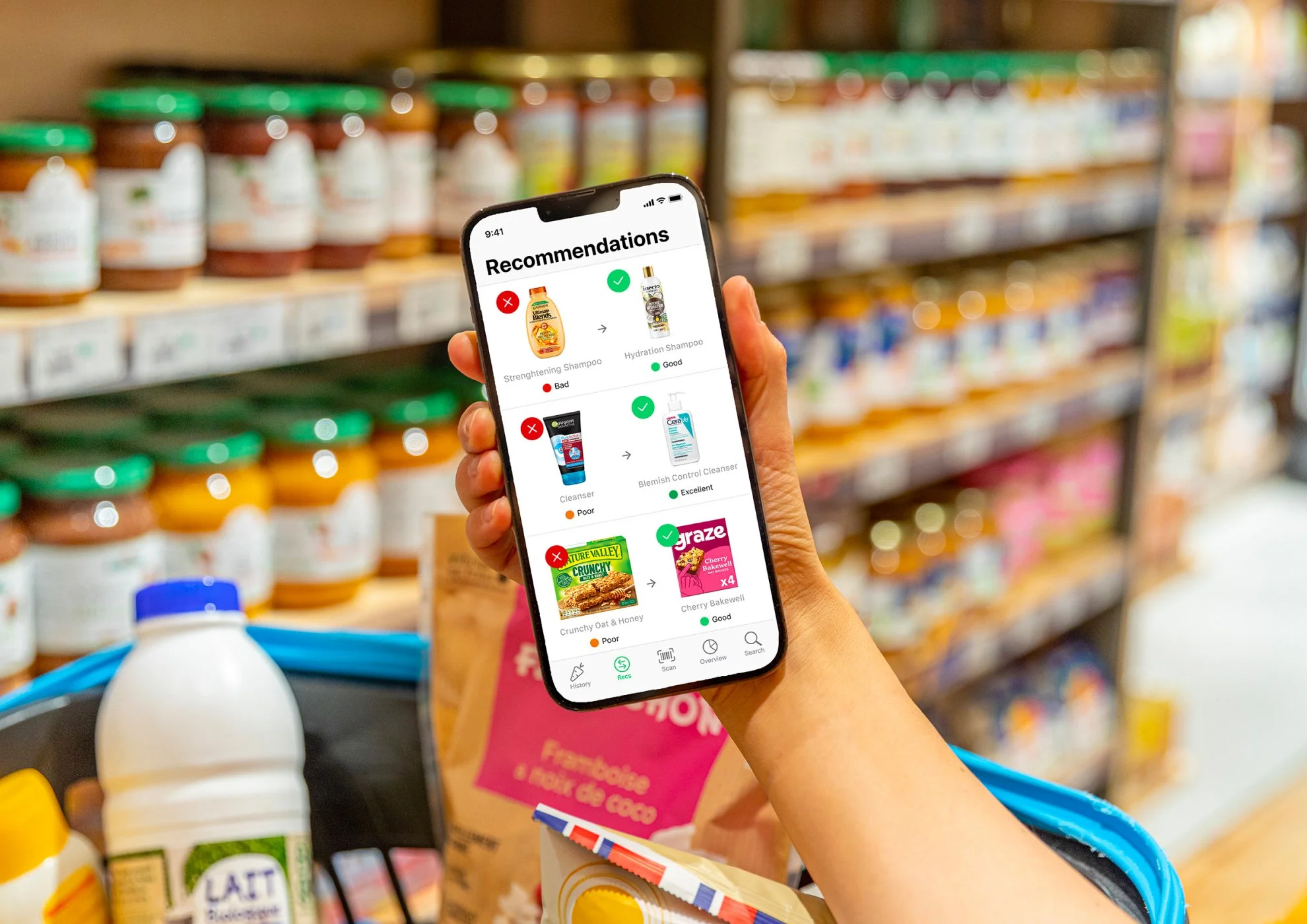
The Social Proof
On Reddit's ultra-processed food community, users debate Yuka's methodology with the intensity usually reserved for financial advice forums. One user describes scanning a protein bar: "The app gave it a 10/100 score. In the alternative product list there was something with a 90/100 score and I was able to pick that off the shelf instead."
The criticism is equally telling. Users complain about arbitrary scoring, question the weighting of fat content over additives, and debate whether to trust an algorithm with their purchasing decisions. This isn't blind adoption - it's informed scepticism driving demand for better tools.
But it's worth noting the increase of love for giving things a score or a grade! In recent years there has been a huge increase in score-based apps for various types of entertainment, like Letterboxd for films, GoodReads for Books and Belly for restaurant reviews. While it is not quite a complete gamification of these activities, it is adjacent, there is an emotional parallel. The worst rated film of all time on Letterboxd is 0.9/10, so if Yuka says something is a zero, it’s probably best not to eat it!
The Fintech Landscape Today
Financial services haven't ignored transparency. Comparison platforms like MoneySuperMarket and Which? Money Compare have been decoding banking products for years, rating current accounts, credit cards and loans side-by-side. Insurance comparison sites like Confused.com and GoCompare perform a similar function. But none of these replicate Yuka's core simplicity: scan, instant score, immediate alternative. They require users to manually input requirements, sift through tables, and make their own comparisons. The cognitive load remains high.
Some banks have built transparency into their product design from the start. Monzo and Starling offer real-time spending breakdowns, instant notifications and plain-English explanations of fees. Monzo in particular has reaped the rewards of using simple language across its services. These aren't bolted-on features - they're foundational to how the products work. The transparency is the product.
Boring Money takes a different approach, simplifying the opaque world of pensions and investment fees. The platform translates dense fund documentation into accessible language, grades products on value, and flags hidden charges. It's closer to the Yuka model - an independent layer that decodes complexity - but still requires users to seek it out rather than encountering it at the point of decision.
The sustainability space shows where this could head next. Doconomy measures the carbon footprint of every card transaction. Tred calculates the environmental impact of purchases. Cogo links spending to climate goals. Each app turns opacity into instant feedback - exactly what Yuka does for additives.
The Gap
But in my humble opinion, these products are yet to have Yuka's frictionless simplicity. There's no equivalent moment in fintech where you tap your phone against a credit card offer and see an instant 0/100 rating flash red, with three better alternatives suggested on the spot. The comparison sites exist, but they demand effort. The transparent banks exist, but you have to already be their customer. The pension platforms exist, but you have to know they're there.
Why This Matters for Fintech
The Yuka effect reveals something fundamental about consumer expectations in 2026: complexity is no longer a defence. If an app can decode the safety profile of six million products, why can't one explain whether a savings account is actually competitive? If a barcode scan can flag hidden additives, why can't a tap reveal the true cost of a credit card? Many are already making steps in that simplified direction, as outlined here, but if at this current rate and if Yuka’s influence is anything to go off of, soon consumers will demand simplicity across the board.
What Could Come Next
The fintech equivalent is starting to take shape. Neo-banks advertise "no hidden fees" as a core feature. Investment platforms promote "plain English" explanations. Insurance companies build in comparison tools. These aren't just marketing tactics - they're defensive moves against a future where every financial product could be scanned, scored, and compared as easily as a packet of biscuits.
The companies that recognise this shift early will reformulate their products for transparency. Those that don't risk finding themselves with the equivalent of a 0/100 rating, watching customers choose alternatives with a single tap.
So in my eyes, the Yuka effect isn't about a food app, it's about the end of complexity as a business model, something that could change the playing field across fintech.